
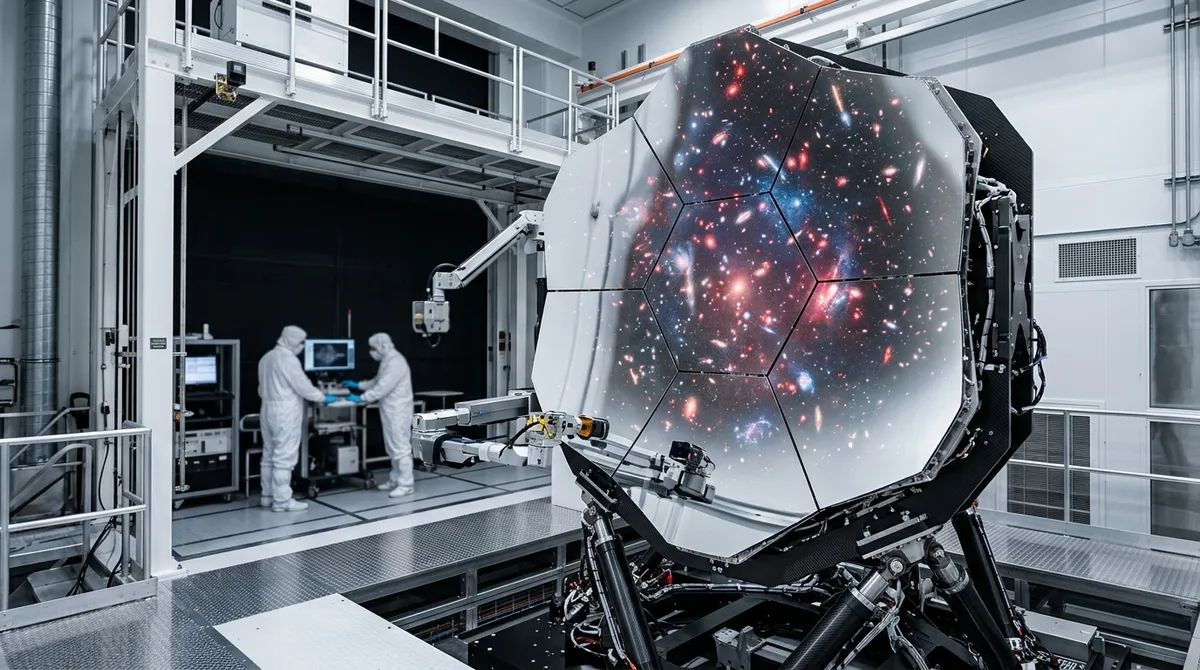
NASA Achieves Major Milestone in Space Telescope Development
NASA has successfully completed the final inspection of the Roman Space Telescope's primary mirror, marking a significant milestone in the agency's preparation for what promises to be a transformative new era of cosmic discovery. The 2.4-meter infrared instrument represents a marvel of precision engineering that will soon enable groundbreaking observations of the universe.
Engineering Precision Beyond Human Hair Thickness
The completed mirror showcases extraordinary engineering achievements, featuring an ultra-thin silver coating that demonstrates the extreme precision required for space-based astronomical instruments. According to reports, this coating is hundreds of times thinner than human hair, highlighting the meticulous attention to detail necessary for optimal infrared observations.
This level of precision engineering represents years of careful development and testing, ensuring the mirror can withstand the harsh conditions of space while maintaining the optical clarity needed for scientific observations.
Complementing James Webb's Cosmic Vision
The Roman Space Telescope's infrared capabilities are designed to work alongside and complement the James Webb Space Telescope, creating a powerful combination for space-based astronomy. While both telescopes operate in infrared wavelengths, Roman's specific design and capabilities will offer unique perspectives on cosmic phenomena that scientists have been eagerly anticipating.
This complementary approach allows researchers to tackle cosmic mysteries from multiple angles, providing more comprehensive data about the universe's structure and evolution.
Targeting Universe's Greatest Mysteries
The Roman Space Telescope is specifically designed to address some of astronomy's most pressing questions. According to reports, the telescope will focus on understanding dark energy, identifying habitable exoplanets, and studying galaxy formation processes that have shaped our universe over billions of years.
These research objectives represent some of the most fundamental questions in modern astrophysics, and Roman's advanced capabilities are expected to provide unprecedented insights into these cosmic phenomena.
International Collaboration Behind Single Component
The completion of this mirror represents the culmination of decades of international collaboration and development. According to reports, this single component embodies years of coordinated effort between scientists, engineers, and institutions working together to push the boundaries of space-based observation technology.
This collaborative approach has been essential in developing the sophisticated technologies needed for Roman's ambitious scientific mission.
Launch Readiness and Scientific Anticipation
With the primary mirror inspection now complete, the Roman Space Telescope moves closer to launch readiness. Scientists are reportedly most excited about the telescope's first observations, which will mark the beginning of a new chapter in space-based astronomy.
The telescope's 7.9-foot diameter mirror will enable detailed observations across vast cosmic distances, potentially revealing new insights about the universe's expansion, the nature of dark energy, and the prevalence of potentially habitable worlds beyond our solar system.
Looking Toward Cosmic Discovery
The completion of Roman's primary mirror represents more than just a technical achievement—it signifies humanity's continued commitment to understanding our place in the universe. As the telescope approaches launch readiness, the scientific community anticipates the wealth of data and discoveries that will emerge from this sophisticated instrument.
The Roman Space Telescope's infrared capabilities, combined with its precision-engineered mirror, position it to make observations that could fundamentally change our understanding of cosmic evolution, planetary formation, and the mysterious forces shaping our universe on the largest scales.